
Slitting is a critical, high-volume operation. If you convert wide rolls into narrow strips, the efficiency of your line is vital. This success rests on the industrial slitter blades. A poor blade choice costs you money. It means more scrap and costly downtime. It also results in wasted material. Many suppliers focus only on basic product specs. They skip lifecycle and maintenance details. This guide will walk you through blade selection. You will learn what every supplier often skips. You will gain mastery over your industrial slitter blades.
What are Slitter Blades and Why Do They Matter?
Slitting cuts a wider web or roll into narrower widths. The blade must maintain consistent blade sharpness. This happens across the entire production run. Industrial Slitter Blades are specialized cutting tools. They are essential automation components in converting processes. Improper blade choice drastically increases waste. It causes edge fraying and burrs. This leads to costly machine stoppages. The blade is the core of your manufacturing equipment.
Role of Industrial Slitter Blades in Different Industries
These industrial blades provide the needed precision slicing. They are used extensively across many fields. This includes flexible packaging and paper mills. They are also vital in metal fabrication. Choosing the right blade affects quality and speed. A good slitter knife maximizes your yield.
Slitting Methods & Blade Types
The method used depends on the processed material. The right method dictates the correct blade type.
Razor Slitting (Slot/Razor Blades)
This method uses thin industrial razor blades. These razor slitter blades are mounted at an angle. They cut the web against a solid roller. This technique is best for thin films and foil. It is also ideal for adhesive tapes. Its advantages are speed and cleanliness on delicate materials.
Shear Slitting
Shear slitting works like a pair of scissors. It uses two coordinated knives. These include the top circle blade and the bottom slitter knife. This is the method for thicker materials. It works well on paper, cardboard, and non-woven fabrics. Cut quality depends highly on the correct clearance.
Score (Crush) Slitting
This method uses a hardened round blade or wheel. It presses the web against an anvil roller. Pressure crushes and tears the material. It is used when the edge finish is less critical. It is common for labels and very thin paper.
Circular Slitter Blades (Rotary Slitting Knives)
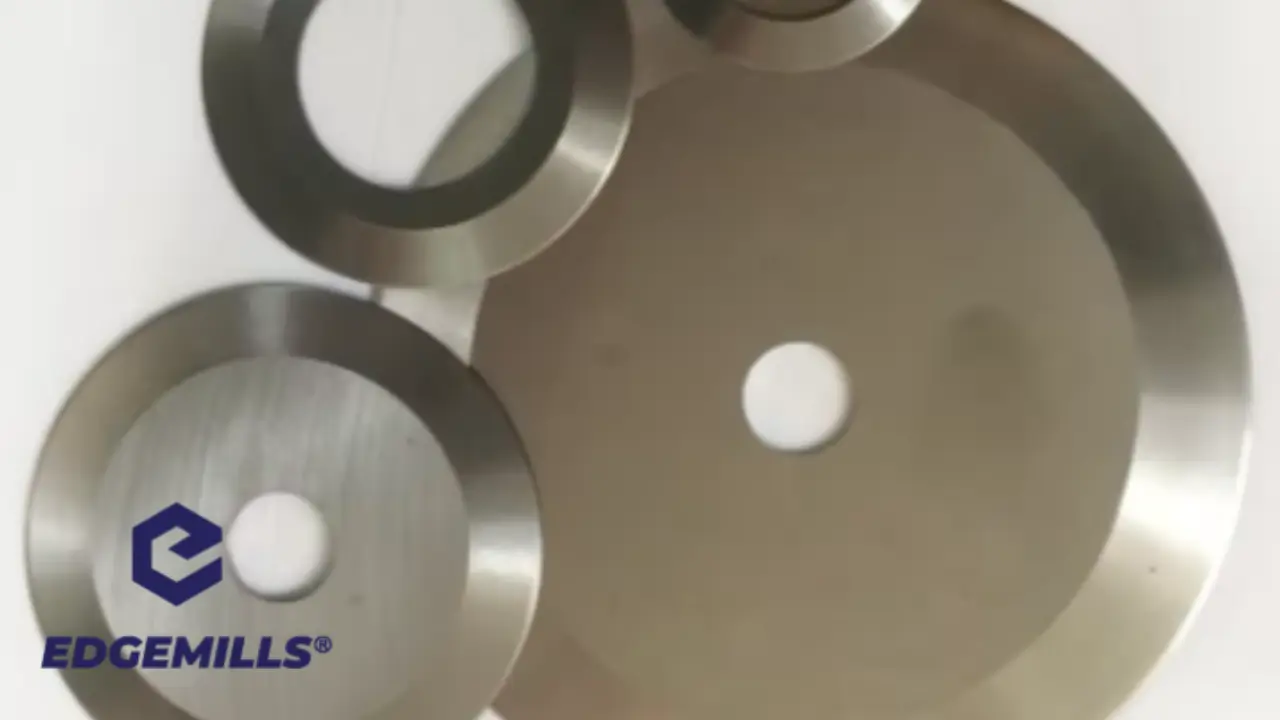
These are robust disc-shaped circle knives. They are used in shear slitting and heavy-duty cutting. They are often called rotary slitter knives. They are essential for metal fabrication and high-speed processing.
For more information on shear cutting, see our article on Shear Blade geometry.
| Method | Blade Type | Best For | Typical Materials | Key Caution |
| Razor Slitting | Slotted or 3-Hole Razor Blades | Thin, Delicate Films | Plastic Films, Foils, Tapes | High risk of blade vibration (chatter). |
| Shear Slitting | Top & Bottom Circular Slitter Blades | Thicker, Stable Webs | Paper, Textiles, Flexible Metal | Requires an exact correct clearance setting. |
| Score Slitting | Smooth/Dull Circle Blade | Pressure-Sensitive | Labels, Thin Paper | It can create dust and rough edges. |
Slitting Blade Materials, Coatings & Geometry
Choosing the right material is a difficult balancing act. It must balance hardness and abrasive resistance.
Materials: Hardness vs. Toughness
- High Carbon Tool Steel (D2, M2): This is a strong, common choice for general cuts. It offers excellent sharpness retention.
- Stainless Steel: This is necessary where corrosion is a risk. This includes food or medical material processing.
- Tungsten Carbide: This is the choice for extreme durability. It is great for abrasive materials like filled plastics.
- Ceramic: This is used for special applications. It offers heat resistance and non-magnetic properties.
Coatings: Fighting Friction and Adhesives
Coatings are a form of cutting edge technology. They enhance the steel’s performance.
- TiN/TiCN Coatings: These significantly boost surface hardness. They increase the durability and edge life.
- Zero-Friction Coatings (DLC): These are essential for sticky film and adhesive materials. They prevent material buildup. Sollex blades have these specialized coatings.
Geometry: Achieving the Perfect Cut
Blade geometry determines the final cut quality.
- Thickness and Bevel Angle: A sharper angle cuts cleaner but is more fragile. Thicker industrial slitter blades are tougher.
- Single vs. Double Bevel: A double bevel is stronger. A single bevel is for very precise edge control.
- Edge Finish: This detail is critical for minimal burrs and dusting. It ranges up to a high-polish super-finishing process. For specific metal cutting blade needs, consult your custom blade manufacturer.
How to Choose the Right Slitting Blade
Selection must be strategic. It should never be based on the lowest price.
Checklist of Key Decision Factors
- Material: Is it abrasive or is it sticky (adhesive tape)?
- Machine Specs: What are your speed and tolerance requirements?
- Blade Type: Do you require razor slitting or shear?
- Compatibility: Does the circle knife fit your holder perfectly?
- Edge Requirement: Do you need a burr-free edge for final products?
Calculating Total Cost of Ownership (TCO)
The true cost of a blade is not just the sticker price. It includes lost production time. TCO considers the blade cost plus the downtime cost. A premium tungsten carbide slitting blade might cost more initially. But if it runs ten times longer, it is the cheaper option. It saves on costly, unscheduled downtime. Investing in a high quality industrial blade is a smart business decision.
Blade Maintenance, Longevity & Performance Optimization
Proper care is the only way to maximize the lifespan of your industrial knives.
When to Sharpen vs. When to Replace
Do not wait for performance to drop. Proactive sharpening removes less material. This extends the blade’s life. Signs of wear include edge rounding and burrs. Always manage the maximum number of resharpening cycles. This prevents failure under stress.
Best Practices for Optimization
- Installation & Alignment: Incorrect mounting causes rapid edge breakdown. Always check overlap and correct clearance in shear slitting.
- Downtime Impact: Every minute of downtime is a direct cost to your business. Excellent maintenance impacts yield and cost. Blade resharpening should be done by certified knife blade manufacturers.
- Safe Handling & Disposal: Safe handling is critical during blade changes. Used blades must be safely disposed of.
For custom industrial blades solutions, get a personalized Quote Today.
Operational & Safety Considerations
Safety and compliance are non-negotiable standards.
Safety and Industrial Slitter Blades
Always follow lock-out/tag-out procedures for safety. Use puncture-resistant safety gear when handling all industrial knives. Proper mounting and holder alignment ensure safe operation.
Environmental/Sustainability Dimension
Longer-life industrial slitter blades are more sustainable. They reduce waste and the frequency of tool replacement. Look for industrial knives and blades manufacturers who offer recycling programs.
Innovations, Trends & What’s Next in Slitting Blades
The future of industrial slitter blades is defined by Sharp Edge Technology.
- Smart Coatings: Advanced coatings are always improving. They allow faster speeds with difficult materials.
- Predictive Maintenance: Sensors monitor blade condition in real-time. This allows for planned maintenance. It virtually eliminates sudden breakdown.
- Emerging Materials: New powder metallurgy steels are coming. They meet the extreme demands of ultra-thin films.
For specialized cutting challenges like paper, consult our experts on Paper cutting Knives.
Conclusion
Mastering the selection and maintenance of Industrial Slitter Blades is a true competitive advantage. It improves efficiency and cuts costs. Focus on the right material and geometry. It is time to audit your current blade setup. Review your waste statistics. Consider optimizing your material choice. Let the right slitting blade transform your production line.
FAQs
What is a steel slitting machine?
A steel slitting machine is specialized manufacturing equipment. It is primarily used in metal fabrication. It uncoils a wide steel coil. It cuts it longitudinally into narrower strips. This uses large, heavy-duty metal cutting circular saw blades.
Would tungsten carbide make a good blade material?
Yes, Tungsten Carbide is an excellent blade material. It offers exceptional hardness and abrasive resistance. It is used for challenging, highly abrasive materials. It lasts much longer than steel in tough applications.
Can wood blades be used on metal?
No. Wood Cutting Blades and metal blades use different steels. They have completely different geometries and angles. Using a wood blade on metal is highly dangerous.
What kind of blade do you use to cut steel?
You use a heavy-duty metal cutting blade. This is typically a large, robust circular slitter blade. They are often made from high-speed steel or tungsten carbide. The geometry must match the steel thickness.