
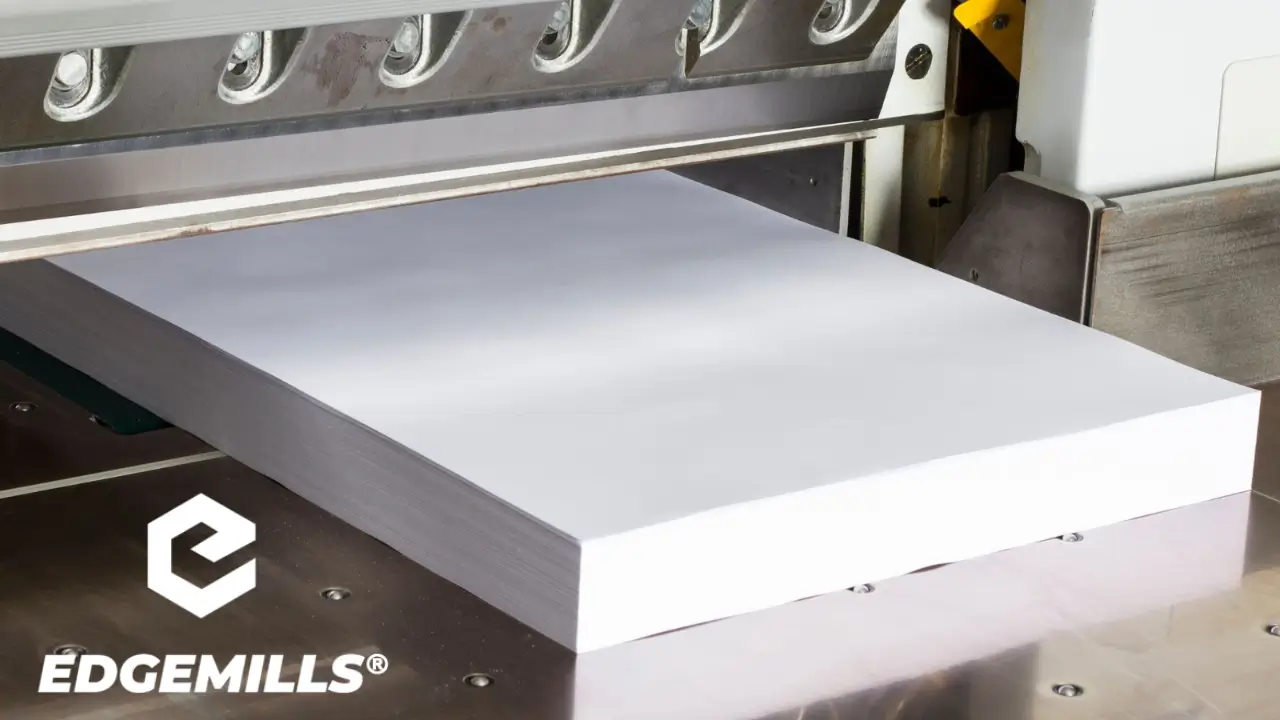
In commercial printing and binding, the guillotine paper cutter is your main workhorse. Your output’s true measure, speed, quality, and cost, is not the machine itself. It is found in the knife. For every stack leaving the press, the paper cutting knife makes the final statement. When that knife is wrong, your profits are cut just as fast as your paper.
Many professionals see the blade as a simple, consumable part. At Edgemills, we see it as a precision instrument. It demands specific engineering expertise. This is the complete guide to mastering your guillotine paper cutter blade. It covers the science, maintenance, and economics. This guide is designed to push your shop’s efficiency to its absolute limit.
Anatomy Behind the Guillotine Paper Cutter
To master the knife, you must understand the physics of the perfect cut. You need to know why the guillotine Paper Cutter blade requires a specialized design.
Why Standard Steel Fails the Print Shop Test
Paper is not soft; it is very abrasive. Coatings, minerals, and clay act like sandpaper on the cutting edges. Standard, low-grade steel cannot resist this constant grinding. It quickly gets dull, chips, and forces the motor to strain. This causes common defects like paper dusting and burrs.
Choosing Your Metal: HSS vs. Carbide Inlay
The lifespan and material durability of your knife depend on your material choice.
- High Speed Steel (HSS): This is the industry gold standard for a reason. HSS offers superb toughness. It can be ground to extreme sharpness. It is ideal for general paper, cardstock, and common binding materials. HSS provides reliable performance and allows for easier maintenance.
- Tungsten Carbide Inlay: Choose Carbide when handling difficult, abrasive materials. This includes recycled paper or thick laminates. Its extreme wear resistance is non-negotiable for these jobs. It significantly extends the time between sharpenings. While more expensive, its longevity makes it the cheapest choice long-term.
The Non-Negotiable Rules of Alignment
Even a premium paper cutting knife will fail if the guillotine Paper cutter is set up incorrectly. This is where most shops lose profits on spoiled stock.
The Critical Role of the Knife Gap
The distance between the knife edge and the cutting stick is the knife gap. This precise distance determines the quality of your cut. If the gap is too large, the knife tears the bottom sheets. This results in fuzzy edges and wasted stock. Set the gap perfectly to prevent strain. This maximizes the life of your cutting edges.
Understanding Blade Angles and Rake
Your knife’s blade angles are custom-engineered for your machine’s movement. The rake angle is crucial for smooth shearing. It minimizes paper shifting. Never attempt to change the angle yourself. Only professional sharpening services have the precision grinding capabilities needed. They maintain the exact manufacturing quality of your paper guillotine blade.
Expanding Beyond Paper
If your shop cuts specialty items, you need the right tools. Your guillotine Paper Cutter trimmer may struggle with plastic sheets or vinyl. For these jobs, using specialized packaging knives may be necessary. This prevents damage to your primary paper blade.
Troubleshooting and Extending Your Blade Life
A complete guide must offer solutions to common operational defects. This stops problems before they impact your deadlines.
| Defect | Root Cause | Edgemills Solution |
| Fuzzy, Feathered Edges | Dull blade, or the knife gap is too wide. | Get a new blade replacement or professional sharpening. Then adjust the gap. |
| Telegraphing | Clamp pressure is too low, or the machine needs leveling. | Increase hydraulic clamp pressure. Check the entire machine alignment. |
| Excessive Paper Dust | Blade angles are worn, or the material is too soft for the stock. | Upgrade to a Carbide-Inlay knife for superior wear resistance. |
If you cut materials like perforated coupons, use the right tool. Our expertise extends to specialized solutions. This includes the precision required for a perforation blade. It also applies to heavy-duty wood chipper blades.
Calculating True Cost of Cutting (TCC)
Stop worrying about the blade’s price. Start measuring the cost of output. The True Cost of Cutting (TCC) is the key to maximizing profits.
The TCC Formula for Print Shops
The TCC formula shows the financial impact of downtime:
TCC=( Blade Cost + Sharpening Cost + Downtime Cost) / Total Reams Cut
Financial Justification and Get a Quote
A premium knife increases your Total Reams Cut dramatically. This sharply reduces the TCC. This makes the better blade the smarter financial choice. The hidden Downtime Cost is often huge. To find the optimal blade for your shop’s TCC, get a Quote for a specialized analysis.
Your Partner in Performance
Edgemills engineer uptime; we do not just supply knives. We design custom tools for your unique requirements. We use superior manufacturing quality. This guarantees your lowest possible TCC.
FAQs
How to sharpen a guillotine paper cutter?
Professional grinding services must sharpen guillotine blades. This maintains the precise blade angles and geometry. Never use stones or attempt to grind the blade by hand. This will quickly ruin the steel’s temper and reduce the life of the guillotine cutter blade.
Are paper cutter machines really necessary?
Yes, they are essential for any commercial volume or binding operation. They achieve the perfect squareness and consistency needed for book alignment. This finish quality cannot be matched by manual guillotine cutters or trimmers.
Can you use a rotary cutter for paper?
Rotary cutters are for low-volume, flexible jobs like cutting photos or fabric. They are unsuitable for print shops. They lack the high stack capacity, power, and clamping precision of a commercial guillotine cutter machine.
How to cut many sheets of paper at once on a paper cutter?
Clamp the paper stack extremely tight in the guillotine paper cutter to prevent slippage. Your paper cutting knife must also be razor-sharp. A dull blade will crush and tear the paper at the bottom instead of achieving a clean cut.
Does a guillotine blade get dull after a few uses?
A high-quality blade should last for tens of thousands of cuts. Quick dulling is likely due to poor manufacturing quality or an incorrect knife gap setup. It can also be caused by contaminants like staples in the paper stack.