
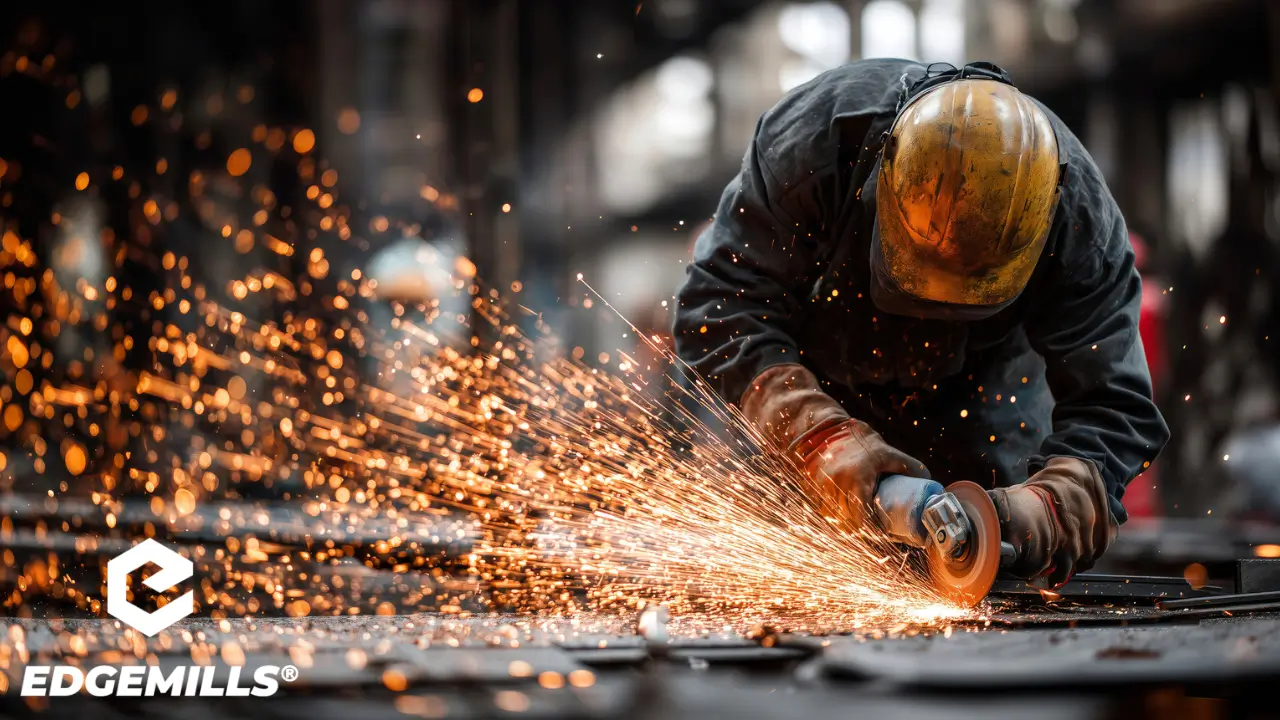
Metalworking is a very high-risk sector in modern manufacturing today. Statistics for 2026 show that metal fabrication causes many workplace accidents. About 15% of all OSHA incidents happen in these busy shops and industries. Over 16,000 serious injuries occur in the industry every single year. Blade lacerations represent 28% of all the injuries found in reports. Machine entanglement and flying debris contribute another 34% to these totals. Following strong Industrial Safety protocols is a moral duty for every shop. These rules prevent $500,000 in annual losses from downtime and legal fees. This guide covers rules for slitting and grinding for Edgemills customers.
1910.212 Machine Guarding + 1910.147 LOTO Industrial Safety Protocols
Industrial Safety begins with a deep understanding of federal machine rules. OSHA 1910.212 establishes general requirements for every machine used in shops and industries. It focuses on the point of operation hazards that can hurt an operator. Every machine part that could cause injury must have a guard. Metal cutting blades must be effectively safeguarded to prevent any serious accidents. In 2026, OSHA focuses on the rule for fixing machines in place. All permanent machinery must be securely anchored to the shop floor now. This prevents machines from moving or walking during high-speed cutting tasks.
OSHA 1910.212 Technical Guarding Specifications
| Requirement | OSHA 2026 Specification | Practical Application |
| Point of Operation | Must be guarded during the entire cycle | Slitter knives between precision guides |
| Revolving Parts | Fully enclosed if located < 7ft from the floor | Exposed chipper drums and flywheels |
| Fixed Location | Securely anchored to the foundation | Guillotine shears and heavy presses |
| Blade Exposure | Guard all but the working portion | Industrial band saws and circular saws |
Control of hazardous energy is the backbone of total workplace protection. The Lockout/Tagout (LOTO) rules under 1910.147 protect every single maintenance worker. The 8-step LOTO procedure ensures that everyone stays very safe while working. An operator might be replacing paper-cutting blades during their daily shift. The machine must not be accidentally energized during this critical blade change. Stored energy, like hydraulic pressure, must be bled from the system completely.
The 8-Step LOTO Standard Procedure
| Step | Action Required | Critical Verification |
| 1. Prepare | Notify all affected employees | Confirm that all are clear of the area |
| 2. Shut Down | Use normal stopping procedures | Verify computer/PLC cycles are off |
| 3. Isolate | Disconnect all energy sources | Electrical, hydraulic, and pneumatic |
| 4. Apply LOTO | Attach standardized locks and tags | One lock, one person, one key |
| 5. Stored Energy | Bleed pressure or ground capacitors | Check for “ghost” kinetic energy |
| 6. Verify | Attempt to restart (Test “Off”) | Ensure the machine is truly inert |
| 7. Perform Work | Complete blade change or repair | Follow Industrial Safety handling rules |
| 8. Restore | Remove locks and notify the team | Ensure guards are reinstalled first |
Blade Handling Safety Protocols
Handling sharp edges is an art that requires very strict discipline. You might work with food-cutting blades in a big processing plant. You might also use heavy duty Wood Cutting Blades in a sawmill. The risks of deep cuts and amputations are always present for workers. Industrial Safety guidelines for blade handling prioritize a no direct touch policy. Use magnetic lifters or special handles to move all sharp machine parts.
Edgemills Industry-Specific Hazard Matrix
| Blade Type | Primary Hazard | 2026 Safety Mitigation |
| Slitter Knives | High-speed ejection | Overlap guarding (0.1mm – 0.5mm) |
| Guillotine | Crush and shear | Interlocked 2-hand control systems |
| Chipper Blades | Material pull-in | Extended feed chutes and shielding |
| Grinding Wheels | Explosive shattering | 180° perimeter safety hoods |
Safe handling also involves very precise industrial engineering for the machines. For instance, when you install Plastic Cutting Blades, check for vibration. Ensuring a runout of less than 0.001 inches is critical for safety. High vibration is a safety hazard that leads to sudden blade failure. It can also cause the metal to shatter during a fast cycle.
Safe Handling & Maintenance Metrics
| Parameter | Industrial Safety Standard | Edgemills Recommendation |
| Handling PPE | ANSI Cut Level A5 | Reinforced Kevlar/Stainless mesh |
| Mounting Torque | 50 – 75 ft-lbs | Calibrated torque wrench use |
| Balance Limit | < 0.001 inch runout | Dynamic balancing for high RPM |
| Edge Storage | Protective dipping/sheathing | Original custom shipping cases |
ANSI/ISEA Metalworking Standards 2026
Personal Protective Equipment is the final defense for every single worker. The ANSI/ISEA 105-2024 standard is now fully effective in early 2026. It uses a special pictogram to show the rating of every glove. Safety managers can quickly identify the cut and puncture resistance of gear. High-quality industrial knives and blades manufacturers always recommend using proper gear. Remember that PPE is not a substitute for good machine guarding rules. An A5 glove cannot protect against the force of metal shear blades.
2026 Metalworking PPE Task Matrix
| Operation | Required Glove Rating | Eye/Face Protection | Hearing Protection |
| Manual Slitting | ANSI Cut Level A5 | Z87.1 Safety Glasses | NRR 25+ Earplugs |
| Heavy Grinding | ANSI Heat Level A4 | Polycarbonate Face Shield | NRR 30+ Muffs |
| Welding/FAB | Leather/Kevlar Mix | Auto-Darkening Helmet | NRR 25+ Plugs |
| Machine Setup | ANSI Abrasion Level 4 | Clear Side-Shields | NRR 20+ Plugs |
ANSI/ISEA 105-2024 Cut Resistance
| Level | Cutting Load Range | Typical Industry Use |
| A1 – A3 | 200g – 1499g | Light packaging and assembly |
| A4 – A5 | 1500g – 2999g | Handling Metal cutting blades |
| A6 – A7 | 3000g – 4999g | Metal stamping and recycling |
| A8 – A9 | 5000g – 6000g+ | Heavy glass and razor-sharp steel |
Barriers, Interlocks, and Presence Sensing
Machine guarding is a vital part of Industrial Safety for metal fabrication. Guarding methods are split into fixed, interlocked, and presence-sensing device types. In 2026, guards must prevent workers from reaching around the safety barrier. The 1.5-inch rule is the standard for guard opening sizes today. At 12 inches away, no opening should exceed 1.5 inches total. This prevents small hands from reaching into the point of operation area.
Guarding Methodology Comparison
| Type | Compliance Level | Best Blade Use | Maintenance Impact |
| Fixed Barrier | Highest | Perimeter protection | Low (Requires tools) |
| Interlock | High | Guillotine access | Medium (Stop-time check) |
| Light Curtain | Medium | High-volume slitting | High (Daily alignment) |
| Pressure Mat | Medium | Robot cells | High (Cleaning req.) |
Safe Guard Opening Distances (OSHA/ANSI)
| Distance from Hazard | Max Allowable Opening | Rationale |
| 0.5″ to 1.5″ | 0.25″ | Prevent finger-tip entry |
| 1.5″ to 2.5″ | 0.375″ | Prevent the first joint entry |
| 2.5″ to 3.5″ | 0.5″ | Prevent full finger entry |
| 3.5″ to 5.5″ | 0.625″ | Prevent knuckle entry |
| 5.5″ to 17.5″ | 0.75″ to 1.5″ | Prevent hand entry |
Training Programs & Near Miss Reporting
A strong Industrial Safety culture is built on good education for workers. OSHA training for 2026 focuses on hazard recognition and leading indicators today. Companies now track near misses where an injury almost happened to someone. This helps prevent real accidents before they ever occur in the factory. Reporting these events helps manufacturers reduce actual workplace injuries by 20 percent. Education is just as important as the physical guards on the machines.
OSHA-Compliant Annual Training Matrix
| Topic | Required Duration | Frequency | Key Objective |
| Hazard Recognition | 4 Hours | Annual | Identify “Nip Points” |
| LOTO Certification | 2 Hours | Annual | Hands-on lock placement |
| PPE Selection | 1 Hour | Quarterly | Reading the ANSI Pentagon |
| Emergency Response | 30 Minutes | Monthly | E-Stop and Fire Drills |
Near Miss Reporting Template
| Category | Data Point | Purpose |
| Location | Machine ID / Bay # | Pinpoint high-risk zones |
| Potential | Major / Minor / Fatality | Prioritize engineering fixes |
| Root Cause | Human / Mechanical / Policy | Prevent recurrence |
| Corrective Action | Guard added / Retraining | Close the loop |
Real Metalworking Incidents & Prevention
Real-world examples show why we need strict Industrial Safety rules. In early 2025, a shop in Dallas had a very bad accident. An operator tried to clear a jam without using LOTO rules first. This mistake led to a very painful triple finger amputation that day. The shop had to pay $145,000 in OSHA fines for this event. Proper chest protection saved another worker from a very serious chest wound. A sharp and well-maintained blade is always safer than a neglected one.
Case Study Analysis – Slitter Bypassing
| Factor | Incident Detail | Prevention Strategy |
| Incident | The guard was bypassed manually | Install tamper-proof interlocks |
| Outcome | Triple finger amputation | Enforce “Zero-Tolerance” LOTO |
| Direct Cost | $145,000 in OSHA fines | Edgemills safety audit ($2,500) |
| Indirect Cost | $400,000 in lost production | Automated jam-clearing tools |
Cost Comparison – Safety vs. Non-Compliance
| Item | Cost of Safety Program | Cost of One Amputation |
| Equipment | $5,000 (New Guards) | $150,000 (Direct Med) |
| Training | $1,500 (Annual) | $50,000 (Legal Fees) |
| Admin | $2,000 (Audit) | $300,000 (Downtime) |
| Total | $8,500 | $500,000+ |
Edgemills Safety-Engineered Blades: Houston Precision
At Edgemills, we believe that Industrial Safety starts with the blade quality. We are a leading manufacturer of industrial knives and blades in the USA. Our blades are built to exceed all OSHA 1910.212 safety standards today. This ensures your production line stays efficient and your team stays safe. We provide precision tools designed for the very toughest industrial working environments. Whether you need machine knives or straight blades, our facility can help. We offer same-day shipping on many stock items for your convenience. Get a Quote Today to see how our precision edges can help you.
Edgemills Safety-First Engineering Features
| Feature | Technical Spec | Safety Advantage |
| Balance Certified | < 0.001 inch runout | Minimizes high-speed vibration |
| Material Certs | HSS / D2 / Carbide | Prevents edge shattering |
| LOTO Friendly | Pre-drilled lock points | Simplifies safety protocols |
| Safety Labeling | Laser-etched warnings | Visual handling reminders |
Blade Material Performance & Safety Rating
| Material | Toughness | Hardness (HRC) | Shatter Resistance |
| M2 High Speed Steel | High | 62 – 64 | Very High |
| D2 Tool Steel | Medium | 58 – 60 | High |
| Carbide Tipped | Low | 70+ | Moderate |
| Stainless 440C | High | 56 – 58 | High |
Conclusion
Prioritizing Industrial Safety in your metalworking shop is the best investment you can make. Every rule and guard mentioned helps protect your most valuable asset—your people. High-quality machine blade choices from Edgemills play a huge role in this mission. Sharp and balanced blades reduce the stress on machines and the risks for workers. By following OSHA 1910.212 and LOTO standards, you create a world-class production environment. Safety is not a one-time goal but a daily commitment to excellence. Stay updated on the 2026 PPE standards and keep your training programs active. When your team feels safe, your shop runs better and stays profitable.
FAQs
What constitutes safety in the workplace?
Safety in the workplace is a layered approach using guards and policies. It requires identifying hazards like sharp edges to reduce risks for employees. A safe environment allows every worker to report issues without any fear. This system ensures that every person goes home safe at the end.
What are some safety precautions for Metalworking?
Essential precautions include using machine guards to block all dangerous moving parts. Workers should always wear ANSI A5 gloves when handling Metal cutting blades. Enforce strict lockout tagout rules during every single machine maintenance task today. Keep the floor clean and anchor all machines to prevent any movement.
What are the 5S in industrial safety?
The 5S system stands for sort, set, shine, standardize, and sustain. These steps create an organized and hazard-free workspace for all factory employees. Sorting tools and cleaning machines help prevent accidents before they ever happen. This process makes safety a continuous habit for the entire production team.
What are the principles of industrial safety?
The main principles include the hierarchy of controls to remove hazards early. This means using engineering solutions like guards before relying on safety gear. Proactive risk assessment helps predict accidents by looking at all Industrial Safety reports. These methods create a reliable system to protect every worker in the shop.
How to improve industrial safety?
Improvement comes from a safety-first culture led by the company owners. You should upgrade old machines with the latest light curtains and sensors. Provide high-quality tools from trusted industrial blades manufacturers for better results. Regular training and clear incident reports help find and fix safety problems.